

If you run a directory or listing website, your business model relies entirely on one thing. Leads.
You charge other companies to list their services on your platform. To justify your fees, you must prove that visitors are actually looking at their listings and clicking their contact buttons.
Recently, a client approached us to set up conversion tracking for his local listing business. He was highly optimistic.
His website had been built by a third-party company using a proprietary web design platform. According to the provider’s built-in dashboard, the site was attracting between 2,000 and 3,000 visitors every month.
For a new, highly specialised niche site, these numbers were incredibly high. The client was excited to start charging his listing owners based on this traffic.
He just needed us to track how many of those thousands of visitors were clicking the “Contact” button on each listing.
The “Traffic Drop” Warning
Because the website was built on a proprietary CMS, we did not have the flexibility to install standard tracking tools.
We needed to install Google Tag Manager (GTM) to track the button clicks. To do this, we requested the web provider to add a simple GTM code snippet to the website. We also asked for access to Google Analytics (GA4) and Google Search Console (GSC).
Instead of a simple setup, the web provider responded with a formal consent letter.
The letter asked the client to agree that by installing GTM, the provider would not be held responsible for any sudden drop in website traffic.
Naturally, this made the client very anxious. Was adding a standard tracking script going to ruin his traffic? After some consideration, he signed the letter, and we installed GTM.
The Discrepancy (500 vs. 3,000)
Once GTM was live and we gained access to GA4 and GSC, we looked at the data.
The numbers did not match. In fact, they told a completely different story.
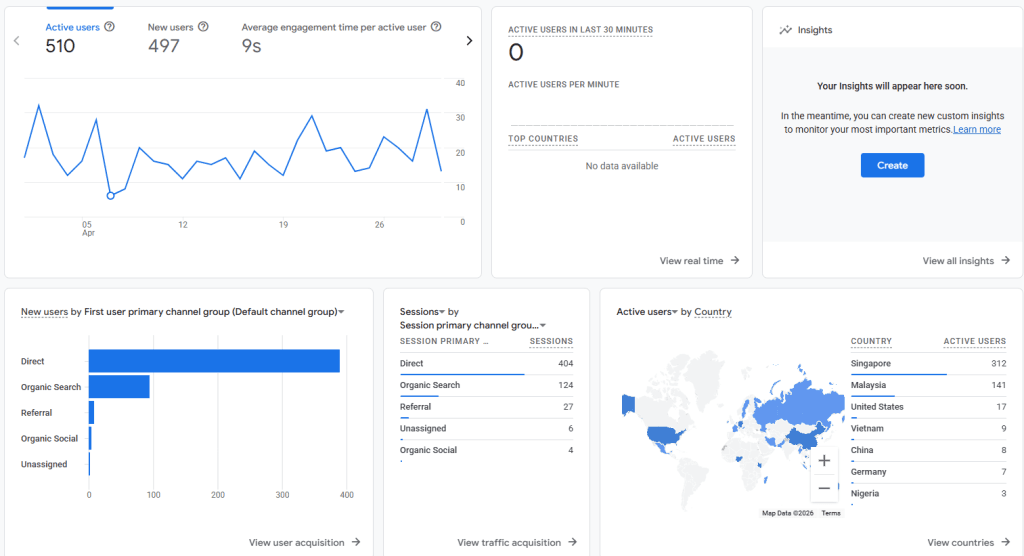
The provider’s dashboard reported 3,000 monthly visitors. Google Analytics showed approximately 500-600 users per month.
To make matters worse, nearly 70% of those 500-600 users were likely automated search bots that GA4 had not fully filtered out, especially from Singapore, as reported by many other webmasters. The actual human traffic was incredibly low.
Our GTM setup confirmed this. Out of all the listings on the site, there were only about 10-15 contact button clicks per month.
The client was skeptical. How could the provider’s dashboard show thousands of visitors while Google showed only 500?
We explained the technical reality to him. After doing his own research, the client realised that Google Analytics and Google Search Console are the global industry standards for a reason. He went back to his provider. Their explanation was simple. They tracked metrics differently.
Why Do Proprietary Dashboards Inflate Traffic?
It is not uncommon for proprietary dashboards to show highly inflated numbers. To give them the benefit of doubt, this is might not be due to malicious fraud. It might be down to a difference in how traffic is defined.
1. Server Hits vs. Human Users
Every time a search engine bot crawls your site, or a browser loads an image file, the server logs a hit. Many basic, proprietary dashboards count every single “hit” as a visitor. If a bot crawls 50 pages on your website, the dashboard might record 50 visitors. Google Analytics, however, uses advanced scripts to ignore these bots and only count real human users.
2. The Niche Logic Check
If a website is brand new and targets a very small, local niche, it cannot realistically attract 3,000 human visitors a month without massive ad spend. Google Search Console shows search impressions. If the search volume for your niche keywords in Malaysia is only a few thousand searches a month, it is mathematically impossible for a new website to get all those organic visitors.

Lessons for Malaysian Business Owners
If you are building an online business, do not rely on vanity metrics to make decisions. Keep these three rules in mind:
- Rule 1: Use Global Standards.
- Always verify your traffic using Google Analytics and Google Search Console. If your web provider refuses to give you access to these tools, or insists on using their own dashboard, treat it as a warning sign.
- Rule 2: Avoid Platform Lock-in.
- When you build your site on a proprietary CMS, you are at the mercy of that provider. You cannot easily install custom tracking, and you do not fully own your platform. Choose open systems like WordPress or a custom setup where you retain full control.
- Rule 3: Focus on Conversions, Not Traffic.
- Having 3,000 visitors means nothing if they are bots. For a listing business, 10 real human clicks are worth more than 10,000 bot visits. Track the actions that generate revenue.
At Solbright Digital Services, we focus on raw, accurate data. We help you cut through the vanity metrics so you can build a business based on reality.
Want to know how much real human traffic your website is getting? Contact Solbright today for an independent tracking audit.